A field guide to the Deepfield collection, its universe and its role as the Genesis layer of the HyperSat protocol.
Chapter 01 / 08
A generative celestial collection
01 — Deepfield
Introduction
Deepfield is the Genesis collection of HyperSat — a collection of 10,000 unique generative celestial NFTs living on Ethereum
Deepfield marks the origin of the HyperSat ecosystem. Its mint represents the boot sequence of the protocol: the moment its Genesis layer begins to take form on-chain.
Each Deepfield represents an object from a shared fictional universe — a planet, a star, a nebula or an exotic celestial phenomenon — generated from its own deterministic seed.
Every object has its own visual composition, identity, celestial name and set of traits. From rocky planets and distant stellar systems to magnetars, quasars and black holes, the collection is designed as an exploration of a vast and diverse deep-space environment.
But Deepfield is more than a collection of isolated artworks. Every object also occupies a defined place inside a larger structure: the Deepfield Universe.
Those relationships connect the 10,000 NFTs together and form the foundation for Universe Graph, Stellar Links and the first active layer of the HyperSat protocol.
Four celestial types
01
Planet
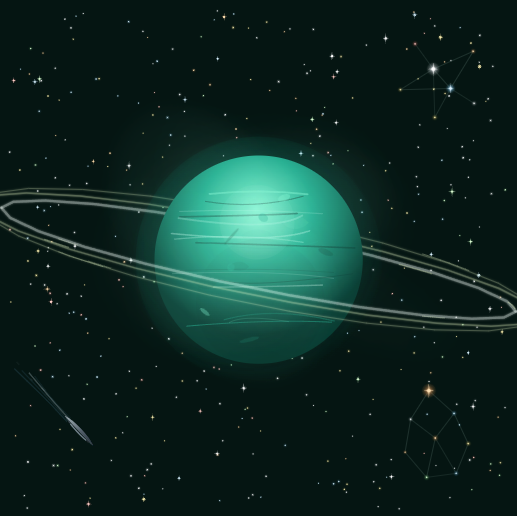
Rocky worlds, gas giants and other planetary environments, with their own surfaces, atmospheres, rings, moons and orbital features.
02
Star
Single and binary stellar objects shaped by different structures, luminosities and energetic phenomena.
03
Nebula
Large-scale deep-space formations ranging from diffuse clouds to more structured stellar environments.
04
Exotic
The most extreme celestial phenomena in Deepfield, including black holes, pulsars, magnetars, quasars and anomalies.
Generated, not assembled
Every Deepfield is generated deterministically from a unique canonical seed.
The seed drives the object's composition and characteristics through the Deepfield generator, while the renderer transforms that scene into its final celestial artwork. The same seed always produces the same Deepfield.
Its canonical seed determines its object characteristics and contributes to a unique celestial name assigned across the collection. Names are deterministic and remain attached to the same Deepfield identity independently of its owner.
Token IDs provide the public Ethereum identity of the NFT, while the underlying canonical mapping connects each token to its Deepfield seed.
Traits & rarity
Deepfields carry traits derived from their generated celestial composition. These describe the characteristics of the object and contribute to its position within the collection.
A deterministic rarity system compares every Deepfield against the complete 10,000-object collection and assigns a global Rarity Rank and Rarity Percentile.
Rarity is a collectible characteristic. It does not increase Mining Power.
Rarity ≠ Mining Power
A collection that already exists
The Deepfield Universe is deterministic.
The 10,000 canonical identities, their characteristics and their relationships are defined independently of who owns them or when they are minted.
Minting does not create the universe — it reveals ownership of a part of it.
One collection. One universe.A Deepfield is not an isolated object. Planets, Stars, Nebulae and Exotics are connected through a canonical network of celestial relationships.
Canonical structure / 02
02 — The Deepfield Universe
One collection. One connected universe.
Introduction
Deepfield is not a collection of 10,000 isolated objects. Together, they form a deterministic celestial network: the Deepfield Universe.
Every Planet, Star, Nebula and Exotic occupies a predefined position within this universe. These relationships are canonical: they are determined independently of ownership, mint order or marketplace activity.
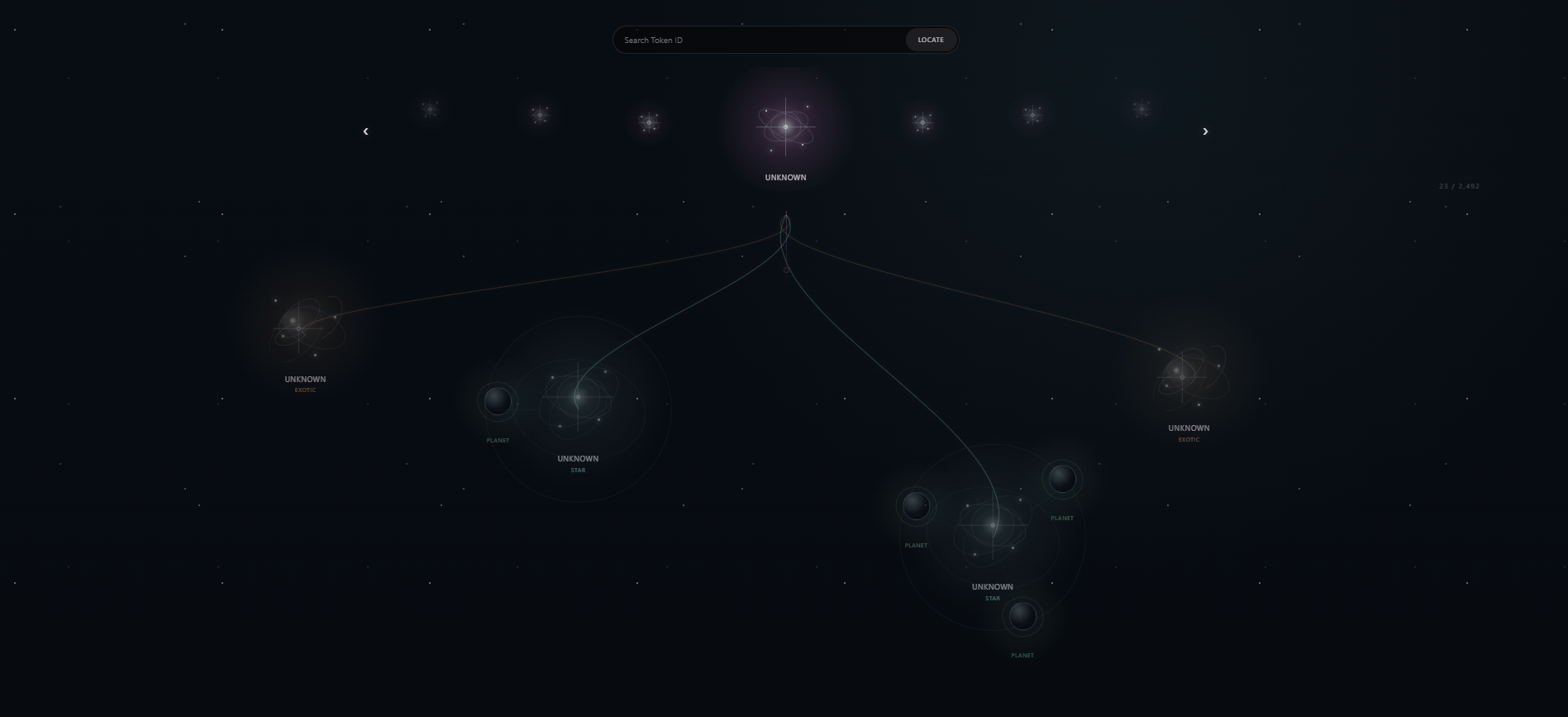
Universe Graph makes this hidden structure visible, turning the collection into an explorable celestial atlas.
A canonical hierarchy
Nebula
↳Star↳ Planet
↳Exotic
Planet → Star → NebulaExotic → Nebula
Nebulae form the large-scale environments of the Deepfield Universe.
Stars belong to a Nebula. Planets orbit a Star and therefore also belong to that Star's Nebula. Exotic objects are independently connected to a Nebula.
This creates a hierarchy shared across the entire collection.
How objects are connected
PLANET
Connected directly to one Star and indirectly to the Nebula containing that Star.
STAR
Connected directly to one Nebula and may have multiple Planets attached to it.
NEBULA
The highest-level structure in the Universe Graph, connecting Stars, their Planets and Exotic objects within the same celestial environment.
EXOTIC
Connected directly to one Nebula, independently of its Stars and Planets.
A universe defined before the mint
The Universe Graph is not reconstructed from wallet ownership or created progressively as NFTs are minted.
The relationships between all 10,000 Deepfields are defined canonically as part of the collection's deterministic universe.
A Deepfield can therefore already have a Star, a Nebula or connected objects even when those NFTs have not yet been minted.
Ownership changes. The universe does not.
Universe Graph
Universe Graph is the interactive map of the Deepfield Universe.
Select any Deepfield to reveal its position in the network, explore its celestial relationships and move between connected objects.
A Planet can lead you to its Star, that Star to its Nebula, and from there to other objects belonging to the same celestial environment.
What begins as a single NFT becomes an entry point into the wider collection.
10,000 objects. One universe.
Across 10,000 Deepfields, Planets, Stars, Nebulae and Exotics form a single interconnected celestial structure.
Their distribution and relationships are part of the canonical Deepfield Universe — waiting to be discovered as the collection unfolds.
Some connections go deeper.
Certain relationships within the Deepfield Universe can play a direct role in Deepfield Mining.
These special configurations are known as Stellar Links. We’ll return to them after looking at how Mining works.
Planet → Star → Nebula ← Exotic
HyperSat protocol / 03
03 — Deepfield Mining
The first active layer of HyperSat.
Introduction
Deepfield Mining is the first active layer of the HyperSat protocol.
It allows Deepfield holders to assemble their NFTs into Mining Slots, contribute Mining Power to the protocol and earn HYPERSAT from its global emission.
A Mining Slot combines twelve Deepfields from across the four celestial types. Once activated, the NFTs are held by the Mining contract and the Slot begins participating in the protocol's shared Mining Power.
Building a Mining Slot
A Mining Slot always contains exactly 12 Deepfields, equally distributed across the four celestial types.
3 × Planet3 × Star3 × Nebula3 × Exotic
↓12 Deepfields↓Mining Slot↓100 Mining Power
All twelve objects are required. A partial Slot cannot be activated.
Any Deepfields can form a standard Slot as long as the required 3 / 3 / 3 / 3 composition is respected. Rarity does not affect its base Mining Power.
A Stellar Link is not required to open a standard Slot.
Mining Power
Mining Power determines a Slot's share of the active HyperSat Mining network.
Every standard Mining Slot contributes 100 Power. Rewards are distributed across active miners according to their share of the total Mining Power at that moment.
If a wallet operates multiple Slots, their Mining Power is combined.
200Your Power1,000Network Power20%Your Share
In this example, the wallet would receive 20% of the HYPERSAT allocated to miners while that power distribution remains unchanged.
Opening a Slot
To activate a Mining Slot, its twelve Deepfields are transferred to the immutable HyperSat Mining contract in a single transaction.
The Slot is atomic: all twelve NFTs are deposited together and remain associated with that Slot until it is closed.
While the Slot is active, the Mining contract holds the NFTs and the wallet that opened the Slot remains the Slot owner and recipient of its Mining rewards.
Wallet↓ 12 DeepfieldsMining Contract↓Active Slot · 100 Power
During an active Slot, ERC-721 ownership belongs to the Mining contract. The user remains the Slot owner and reward recipient; closing returns the NFTs to that wallet.
While a Slot is active
Once active, a Slot continuously participates in the global Mining Power.
Rewards accrue to the wallet through the protocol's accounting system and can be claimed independently of the Slot itself.
A wallet can operate multiple Mining Slots at the same time. There is no one-Slot-per-wallet restriction.
Multiple SlotsSupportedClaim RewardsWithout closingSlot configurationLocked while active
Individual NFTs cannot be swapped, replaced or withdrawn from an active Slot.
Closing a Slot
Mining is voluntary.
The wallet that opened a Slot can close it, removing its Mining Power from the active network and returning all twelve Deepfields to that same wallet.
A Slot is closed as a complete unit. Individual NFTs cannot be withdrawn or replaced while it is active.
Rewards already earned remain claimable after the Slot is closed.
Active Slot↓ Close12 Deepfields returned+Earned HYPERSAT remains claimable
There is no protocol administrator capable of closing a user's Slot or withdrawing its NFTs in the immutable HyperSat Mining V1 architecture.
The global emission
Deepfield Mining does not assign a fixed HYPERSAT reward to each Slot.
Instead, all active Mining Power participates in a single global HYPERSAT emission. Each miner receives a proportional share according to their Mining Power relative to the network.
The emission follows a predefined schedule and begins with the activation of the first valid Mining Slot.
The complete HYPERSAT supply and emission schedule are covered later in the Docs.
What if nobody is Mining?
The emission clock does not stop when Mining Power reaches zero.
Once Deepfield Mining has started, its emission schedule continues even during periods when no Mining Slots are active.
HYPERSAT scheduled during those zero-power periods is permanently burned rather than stored for future miners. There is no catch-up emission or reward backlog.
Mining is not rarity
Deepfield rarity is a collectible property, not a Mining multiplier.
A standard Slot always begins with 100 Mining Power, regardless of the Rarity Rank, Rarity Percentile or visual traits of the twelve NFTs it contains.
Beyond a standard Slot
Every valid Mining Slot begins with the same base power. But some combinations contain something more.
When four Deepfields inside a Slot reproduce one of the canonical relationships of the Deepfield Universe, they can form a Stellar Link and increase the Slot's Mining Power.
Protocol relationships / 04
04 — Stellar Links
When four objects align
Introduction
A Stellar Link is a complete celestial relationship connecting four Deepfields within the same branch of the Deepfield Universe.
It brings together a Planet, the Star it orbits, the Nebula containing that Star, and an Exotic object belonging to the same Nebula.
Unlike a visual trait or rarity attribute, a Stellar Link is defined entirely by the canonical relationships of the Deepfield Universe.
Planet→Star→Nebula←Exotic
The four-object relationship
PLANET
The Planet must orbit the selected Star.
STAR
The Star must belong to the selected Nebula.
NEBULA
The Nebula must be the common celestial environment connecting the system.
EXOTIC
The Exotic must belong to that same Nebula.
All four relationships must match. A visually similar combination is not a Stellar Link.
Canonical, not generated by Mining
Mining does not create Stellar Links. It discovers them.
Stellar Links already exist within the canonical Deepfield Universe. Their relationships are independent of wallet ownership, mint order and Mining activity.
Acquiring the connected Deepfields simply allows a collector to bring together objects whose relationship already exists within the universe.
Finding a Stellar Link
The Mining interface can inspect the Deepfields held by a wallet and search for a complete Stellar Link among the available objects.
Find Stellar Link looks for a canonical Planet → Star → Nebula ← Exotic relationship and, when one is available, uses it as the foundation of a Mining Slot.
The search does not manufacture compatibility or modify the Universe Graph. It identifies relationships already present in the collection.
Stellar Links and Mining
A standard complete Mining Slot produces 100 Mining Power.
When the twelve Deepfields forming that Slot contain a complete Stellar Link, the Slot receives a 30% Mining Power boost, increasing its power to 130.
Only one Stellar Link bonus can apply to a Mining Slot. Finding multiple valid Stellar Links inside the same Slot does not stack additional bonuses.
100Standard Slot Power→+30%Stellar Link→130Linked Slot Power
Rarity does not create a Stellar Link
Stellar Links are structural, not rarity-based.
Rarity Rank, Rarity Percentile, visual traits and celestial subtype do not determine whether four objects form a Stellar Link.
Only their canonical Universe relationships matter.
Discovery without spoilers
Stellar Links are distributed throughout the Deepfield Universe.
Their exact availability is part of the collection's discovery layer. Universe Graph and the Mining tools allow collectors to explore those relationships without changing the underlying universe.
From connection to power
Stellar Links give the structure of the Deepfield Universe a direct role in the HyperSat protocol.
But a Stellar Link alone is not a Mining Slot. To begin Mining, Deepfields must be assembled into a complete twelve-object configuration and deposited into the Mining contract.
HyperSat protocol / 05
05 — HYPERSAT
The protocol token
Introduction
HYPERSAT is the native token of the HyperSat protocol.
Deepfield Mining introduces HYPERSAT through a fixed, deterministic emission schedule shared by all active Mining Power.
Its supply is fixed from inception. No additional HYPERSAT can ever be minted.
The total HYPERSAT supply is permanently fixed at 42,000,000 tokens.
The complete supply is created at deployment. The token contract contains no mechanism allowing additional HYPERSAT to be minted later.
21,000,000 HYPERSAT — exactly half of the total supply — are allocated to Deepfield Mining.
The remaining 21,000,000 HYPERSAT are not part of the Mining allocation. Their final allocation will be documented separately once finalized.
Mining allocation
The 21,000,000 HYPERSAT Mining allocation funds the global emission described in Deepfield Mining.
These tokens are not assigned to individual NFTs or Mining Slots in advance. They are progressively allocated through the protocol’s emission schedule and shared proportionally between active Mining Power.
A miner’s reward therefore depends on the global emission at that moment and the miner’s share of total active Mining Power.
Global Emission×Your Mining Power / Total Mining Power=Your HYPERSAT Rewards
The emission schedule
The Mining emission follows an annual halving schedule.
During the first year, up to 10,500,000 HYPERSAT are scheduled for Mining. The scheduled emission is then divided by two every protocol year.
Annual Mining emission — each protocol year halves the scheduled amount.
When does Mining begin?
The emission schedule does not begin when the contracts are deployed.
It begins at the timestamp of the first successfully activated valid Mining Slot. Before that moment, no Mining emission occurs.
First Valid Mining Slot→Emission Begins
One protocol year
For the emission schedule, one protocol year is defined as exactly 365 days.
Halvings therefore follow fixed protocol durations rather than calendar dates or leap years.
1 Protocol Year = 31,536,000 seconds
Shared emission, not fixed yield
HYPERSAT Mining does not promise a fixed reward per NFT, per Slot or per day.
The scheduled emission is shared between all active Mining Power. As miners enter or leave the network, each participant’s share changes accordingly.
When nobody is Mining
Once the emission schedule has started, time continues to advance even if total Mining Power falls to zero.
HYPERSAT scheduled during a zero-power interval is permanently removed from the Mining allocation through burning.
Zero Mining Power↓Scheduled Emission↓Burned
No backlog · No catch-up
Claiming HYPERSAT
Mining rewards accrue independently of individual claim transactions.
Miners can claim available HYPERSAT while their Slots remain active, and rewards already earned remain claimable after all of their Slots have been closed.
Claiming does not reset Mining Power or restart the emission schedule.
Burnable by design
HYPERSAT can also be voluntarily burned by its holder.
Any holder may permanently destroy their own HYPERSAT, reducing the token’s total supply. No administrator can burn tokens from another wallet.
This voluntary self-burn is distinct from zero-power emission burn.
No hidden monetary controls
The HYPERSAT token contract is intentionally minimal.
It has no mechanism for future minting, transaction taxes, administrative transfer restrictions or upgradeable monetary policy.
The remaining 21,000,000 HYPERSAT are not part of the Mining emission. Their final allocation has not yet been defined publicly and will be documented before they are assigned to ecosystem purposes.
From token to protocol
HYPERSAT begins with Deepfield Mining, but its place belongs to the wider HyperSat protocol.
Deepfield establishes the Genesis layer. Mining introduces the protocol’s first active system and begins HYPERSAT emission.
Deepfield is where HyperSat begins — not where it ends.
The wider protocol will be documented in this closing chapter.
HyperSat protocol / 06
06 — HyperSat Protocol
Beyond Genesis
HyperSat is an Ethereum-native accumulation layer. A self-sustaining system where every action feeds the loop, and every participant strengthens it.
Enter the system. Commit. Stay in the loop.
More to come soon...
Collector guide / 07
07 — Q&A
Everything else you might want to know
Deepfield is the Genesis collection of HyperSat: 10,000 unique generative celestial NFTs living on Ethereum.
Each Deepfield has a deterministic identity, celestial name, traits and position within the canonical Deepfield Universe.
The Public Mint is priced at 0.0017 ETH per Deepfield.
Whitelisted wallets can access a Free Mint at 0 ETH, subject to the Whitelist allocation and per-wallet limits. Network gas fees still apply.
The Whitelist allocation is limited to 500 Deepfields, with a maximum of 20 Free Mints per whitelisted wallet. Whitelist availability is first come, first served.
Yes. Deepfield is deterministic.
The 10,000 canonical identities, their celestial characteristics and their relationships within the Deepfield Universe are defined independently of mint order.
Minting reveals ownership of an existing Deepfield identity rather than progressively constructing the universe.
No.
Rarity Rank, Rarity Percentile, visual traits and celestial subtype do not increase Mining Power. Every standard Mining Slot begins with 100 Power.
A Mining Slot requires exactly 12 Deepfields:
3 Planets · 3 Stars · 3 Nebulae · 3 Exotics
Any valid 3 / 3 / 3 / 3 combination can activate a standard Slot. A Stellar Link is not required.
When a Mining Slot is activated, its twelve Deepfields are transferred to the HyperSat Mining contract.
While the Slot is active, the Mining contract is the ERC-721 owner. The wallet that opened the Slot remains the Slot owner and receives its Mining rewards.
Closing the Slot returns all twelve Deepfields to that same wallet. Individual Deepfields cannot be withdrawn or replaced while the Slot is active.
No. Only the wallet that owns the Slot can close it. HyperSat Mining has no administrator capable of closing user Slots, seizing deposited Deepfields or withdrawing them.
Yes. A wallet can operate multiple Mining Slots simultaneously. Their Mining Power contributes to the wallet’s total participation in the active Mining network.
No. HYPERSAT rewards can be claimed while Mining Slots remain active. Rewards already earned also remain claimable after a Slot has been closed.
A Stellar Link is a canonical relationship connecting a Planet, its Star, their Nebula and an Exotic belonging to that same Nebula.
If a Mining Slot contains a complete Stellar Link, its Mining Power increases from 100 to 130. The bonus is limited to one per Slot and does not stack.
Once the HYPERSAT emission has started, its schedule continues even when total Mining Power reaches zero.
Emission scheduled during those periods is permanently burned. It is never accumulated for future miners or redistributed as catch-up rewards.
No. HYPERSAT has a fixed initial supply of 42,000,000 tokens.
The entire supply is created at deployment and the token contract contains no mechanism for future minting.
Deepfield is the Genesis layer of HyperSat.
The wider protocol remains intentionally undisclosed for now.
More to come soon...
The official references chapter will be available when canonical Mainnet references are ready.
Canonical references / 08
08 — Contracts & Links
Official references
This page is the canonical reference for official Deepfield and HyperSat contracts and project links.
Always verify contract addresses here before interacting with the protocol.
Official contracts
DeepfieldGenesis NFT CollectionPublished at Mainnet launchHYPERSATProtocol TokenPublished at Mainnet launchHyperSat MiningMining ProtocolPublished at Mainnet launch
Only contract addresses published on this page should be considered official Deepfield or HyperSat contracts.
Never rely on addresses shared through replies, direct messages or unofficial third-party pages.
If an address does not match the canonical reference published here, do not interact with it.
Canonical Ethereum Mainnet contract addresses will be published here at launch.
Collection protocol / 01
Deepfield is a field of deterministic worlds.
10,000 celestial compositions, each derived from one seed and reconstructed by the canonical HyperSat Generator-V2 visual engine.
10,000 scenes
DF / 0001
One seed / one scene
Not generated at random. Composed from a system.
Every Deepfield starts with a deterministic seed. Generator-V2 resolves its celestial subject, palette, light, constellations, attached objects and compatible space phenomena into an abstract scene. The renderer is the final, separate SVG layer.
same seedsame scene900 × 900canonical viewport
The visual atlas
A collection with range, held together by one grammar.
Each scene is built from compatible elements rather than a fixed template: a central subject, one to three constellations, and one to three peripheral phenomena.
32 standard and 12 legendary patterns, anchored across the field.
04 / PHENOMENA24 field events
Peripheral phenomena ranging from comets and galaxies to signals, fractures and artifacts.
Canonical reconstructionGenerator-V2
01SeedA stable input
→
02SceneRelations and primitives
→
03RendererCanonical SVG output
The collection is visual-first by design: the generator does not contain SVG, and the renderer does not make random decisions. Reconstructing the same seed therefore returns the same Deepfield composition.
Universe GraphModule / 05
Read Deepfield as a connected universe.
Universe Graph reveals the hidden structure behind the collection. Explore how Planets orbit Stars, how Stars and Exotics belong to Nebulae, trace Stellar Links across the collection and navigate all 10,000 Deepfields as one interconnected celestial atlas.
MiningModule / 06
The HyperSat protocol starts here.
Deepfield Mining opens the first active layer of HyperSat. Assemble twelve Deepfields into a Mining Slot, become one of the protocol’s earliest miners and earn HYPERSAT from the very beginning of its emission schedule. Discover a Stellar Link for a 30% power boost and join the pioneers powering the system from day one.

 01
01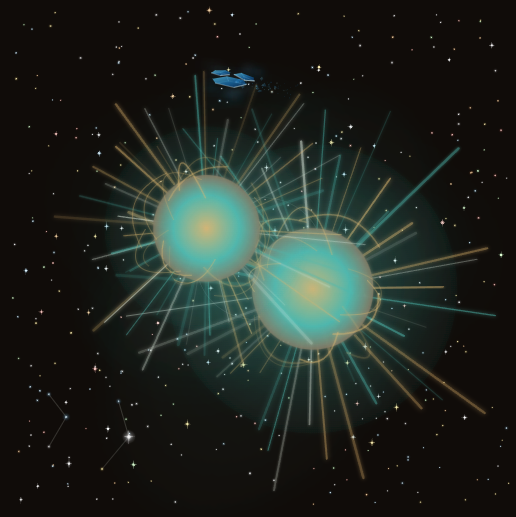 02
02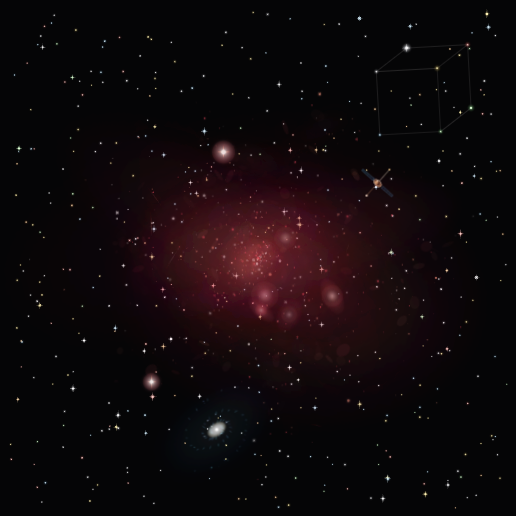 03
03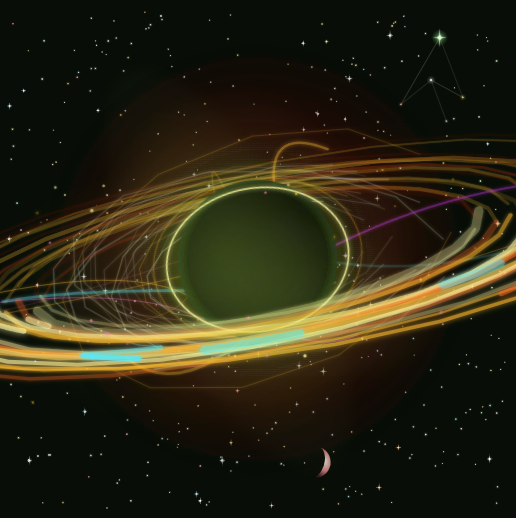 04
04